Category: Game development

  • MAGS Day 4 – Splitting headache

    Yesterday I didn’t get a lot done because my iPhone broke down and I spent all afternoon fixing it. On top of that I discovered in the evening a few glaring oversights in my dialog engine that required a complete rethink of it’s structure. So yeah, great day…

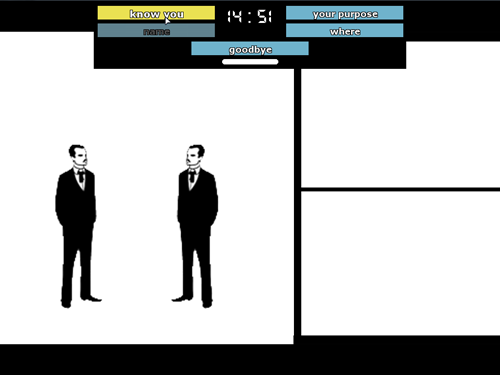
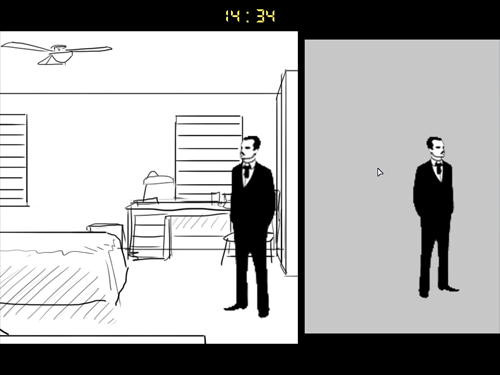
    Today was decidely better. I solved most of the problems I uncovered yesterday, and after a long struggle I got the splitscreen feature working aswell! It’s not perfect but it’ll have to do.


    The fun is that the room you are in (the frame on the left) is a scrolling room, so it will keep scrolling as you walk around while the frame on the right (an object) stays in place. 🙂

    There’s this strange phenomenon that has happened to me at least a dozen times now where I type up a post on the forums describing the problem and asking for help, and almost always right before I hit the POST button I come up with either a solution or a workaround! It’s a funny thing.

    I also sketched out all backgrounds today, so I can finally start building rooms now and get this thing underway proper!

  • MAGS Day 2 – Off to a good start

    Today started off a little slow but I made good progress in the evening.

    I decided to really embrace the 24 tropes and make a parody/homage game out of this. This has the added benefit that I don’t have to spend time fleshing out characters since eight seasons of 24 already did that for me! Now I can get right to the meat of writing the story.

    Building on the scraps of story I penned yesterday I wrote the full scenario for the game today. I’m trying to avoid what I did with Coyote where I wrote too much story and not enough good puzzles. The first half of the scenario started to feel a bit like that after I wrote it, but I managed to fill it up with more interactivity later.

    To keep things simple, I limited the number of locations to 4. I have enough complicated stuff to put in as is, I don’t need more backgrounds to draw. From experience I’ve noticed the art is usually the main thing stalling development, since I get more instant satisfaction from creating and testing a piece of code (a slightly worrying development for an illustrator…). So this was probably a wise decision. And after writing the scenario it turned out one of the four locations was only really needed in a cutscene, so I don’t have to spend as much time on it as the others 🙂

    So now the game needed a working title. My first hunch was to name it ’12’, possibly referring to the number of minutes you’d need to complete it. That might be a bit too short thought, so I upped it to 15 minutes.

    To start things off I decided to recreate the 24 title sequence for the start of the game. I tracked down the fonts and downloaded some 24 soundtracks, then fired up After Effects. I’m pretty pleased with the result of some simple masking and a few keyframes. I could have made it resemble the source material even closer, but that was not the point of the exercise.

    [vimeo 21895542 w=520 h=260]

    Now it was time to tackle the biggest feature of the game – the realtime clock. Thankfully Monkey_05_06’s Countdown module could do most of the work for me (I like it when that happens). I slapped it on a GUI and man, it works like a charm. I already experimented with triggering some events at a certain point during the countdown, and so far it seems to work just dandy. The only problem I had was with sound files being triggered more than once (since I check the timecodes in the rep_ex).

    I then imported my custom dialog engine and repurposed a few bits to suit this game. Seeing that ingame got me really excited!

    My next challenge will be to tackle the splitscreen – another staple of the 24 show. I have a few ideas on how to do it, we’ll see tomorrow which one will work best.

  • MAGS Day 1 – From vague to viable in one constraint

    Every month the AdventureGameStudio forum runs a competition where you build a game in one month following a specific theme. This month the theme is Time. I’ve never participated in MAGS since I usually don’t have time, but this theme sparked an idea in my head. An idea I’ve been throwing around for a while now, based on the tv show 24.

    24, as you may or may not know, is a show that purports to portray a full day in the life of special agent Jack Bauer in REALTIME. Every episode is an hour long, with appropriate lulls written into the plot to accomodate commercial breaks. But the funny thing is that during the show Jack never seems to take the time to chow down a sandwich, or even to take a piss. I thought that was interesting, and formed some ideas on how to handle that and convert the format into an adventure game. But nothing conclusive ever came out of that, mostly because there were so many directions you could take it in. So I tucked the concept away in my ideas folder. Until yesterday.

    As a freshman in game designer college, me and my classmates all wanted as little restrictions as possible during our assignments. Every constraint the teachers put on us was met with a groan. But over the years we learned that constraints actually benefit your design because they allow you to focus on a specific direction and discard anything that doesn’t match that direction. So too the constraints of MAGS (mainly the time limit, appropriately) suddenly made all those vague ideas click together, and I decided to give it a go.

    A month is a decent amount of time to make a small game, but I have plenty of other, more urgent things to do aswell, so I decided on a few more constraints from the onset:

    – First and foremost I will keep this game as simple as possible. I can always expand later if I have time left.
    – Secondly I want to try out the idea of making everything realtime. That means keeping track of the time the player spends in the game and where he is at when the time limit expires. So that means multiple endings. Woof, okay.
    – Thirdly, I wanna use this as a test case for the custom dialog engine I am writing. It’s still very much in beta, but this will be a good opportunity to use it in a real project and see what improvements can be made.

    Let’s see how it goes!

  • Stop caring

    Tonight’s Gamelab discussion on gameplay has galvanized for me more than ever the belief that the whole gameplay vs narrative debate is pointless and who cares. Not because it is frustrating or because I am indifferent, but because the whole thing is irrelevant. We will never reach a concencus on this because everyone has a different opinion, and that is why we dont need a consensus.

    Whenever you make something there will always be people who won’t like it, or at least remain indifferent about it, even when that something is as big as Call of Duty or Pulp Fiction or The Beatles. It’s simple, if you like something, you like it, and if you don’t, you don’t. There is no right or wrong in there. You can of course strive to maximize the amount of people who do like it, but before you do, ask yourself if it helps your goals as a designer? There is of course the business aspect, but in the end we are all in this because we like making games. We like doing what we do, and why should we sacrifice part of that to please more people?

    There will always be people who will want to play another Crysis, and people who will want another Super Crate Box. We don’t have to win over all of them. Find the niche that speaks to you and forget about the rest. If you put your heart in something you’ll find a way to make it work.

  • What’s been cooking

    So last week we wrapped up the school project we’ve been working on for the past two months. It’s called Overleven op Drakeneiland (survive on Dragon Island), and it’s a cardgame based off a well-known children’s books series here in Holland.

    Drakeneiland is set on an island off the coast of Greece where difficult children from Holland are sent after they do something bad. The island is completely devoid of adults, so the children have to maintain a society of their own, where everyone contributes to the greater good. It’s very Lord of the Flies, without all the violence.
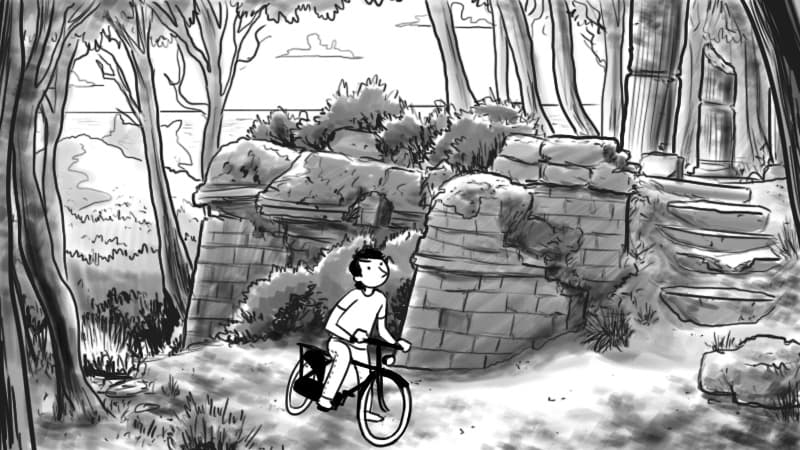
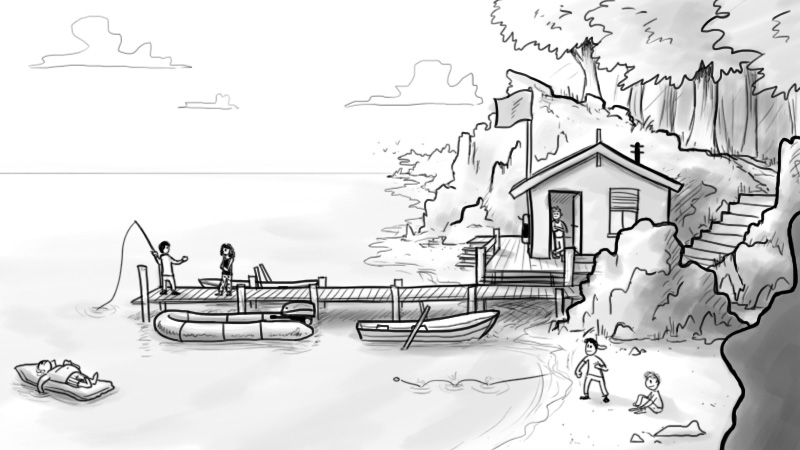
    Writer Lydia Rood wanted a game to accompany her books that would explore a different side of the franchise. It had to be an expanded universe thing, so we couldn’t recreate one of the books as an adventure game for example. But since the books deal mostly with social interaction, we decided a roleplaying cardgame was the perfect solution. A physical game would be much more fun to play for the target audience aswell (kids between the age of 8 and 10).
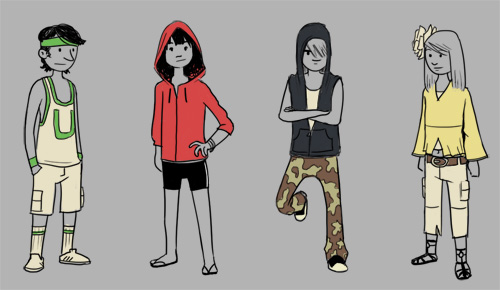
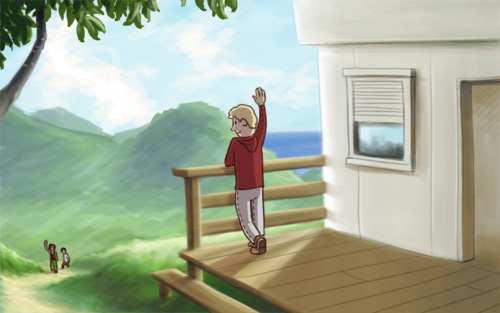
    After a lot of research into Greccian architecture, nature, clothing and different visual styles, balancing the cards and a lot of playtesting, we produced a working prototype.

    It consists of a deck of cards, money (the copper sticks) and points (the shiny gems). The deck consists of three different types of cards: blue cards, which signify a profession with a special talent each players has to pick at the start of the game, and green and red cards, which respectively have a good or a bad influence on the game. With these cards you have to collect as many of the shiny gems as you can, and you pay for the cards with the copper sticks.

    In addition to that, we built a digital companion in Adobe AIR, that scans each card and tracks player stats like karma and number of points. Each profession has it’s own iconic backdrop in there aswell. This allowed us to put more detail into the artwork there that we could not put in the playing cards, because we wanted to keep those as iconic and easy to understand as possible. We use a lot of icons throughout the game anyway, to avoid long blocks of text.
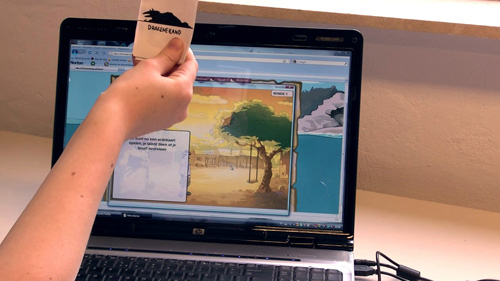
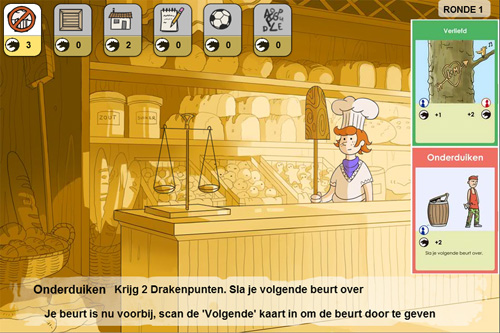
    I designed all the playing cards and their illustrations, and my colleague was responsible for the digital companion. This allowed us to put more detail into the companion to complement the iconic simplicity of the cards.

    Reactions were very positive, both from the kids and the client alike. In the end we found that no matter what age players were, they all had the same learning curve, and all had the same enjoyable experience.

    The client was so pleased infact that they want to sit down with us after the summer vacation to discuss how we can get this product on the market! So expect to be hearing more about this soon…

  • Indigo

    So last week was Indigo, the first Dutch indie game developer conference, and I was there with Monkeybizniz, finally demoing the game we’d been working on during my internship.

    Friday evening was great, and we already got a lot of good responses to the game, including from our client! Met a bunch of interesting people aswell. Basically everybody who’s anybody in the (Dutch) gaming industry shows up to these events.

    On saturday the show was also open to the public. But trouble loomed as we were setting up in the morning:

    Some last-minute fixes by Dimme last night had broken the engine, so we had to to some quick troubleshooting. But luckily we got everything in order quite quickly. After that it was smooth sailing, and we had some good traffic during the day. Biggest surprise was that save one or two people, everybody who started on the demo actually finished it. That’s good news for us – we must be doing something right!

    In the afternoon I left the booth in the care of my colleagues and toured the expo with a friend. There were a lot of interesting games to see – a labroscopy simulator on the Wii, and multiplayer version of Scrabble and Chime, a very good-looking adventure game based on Christian stories, and for us perhaps the game of the show: Jimmy Pataya, the skydiving extravaganza on iPhone from Paladin Studios.

    I really enjoyed Indigo, got to see lots of interesting games and meet lots of interesting people. Already looking forward to next year!

  • Closure

    Closure

    Guess it’s about time for an update eh?

    I wrapped up my sophomore year a few weeks back. Passed all my classes in one go, and the project turned out very well! I worked on Will O Wisp, assisting with game design, concept art, creating pretty much all the textures and putting together the audio and gameplay trailer. I think we put together a pretty nice game if you look at where we started, with artists that knew very little about 3D, and programmers that had never programmed for games before.

    So now I finally have some free time again to work on some personal projects (and to look for an internship). I’ve started working on Dinerdate again, finalizing the script and characters, and drawing the first few strips. It’s a little slow because I’m still experimenting with fonts and word balloons and coloring techniques, and I gotta get familiar with the characters again – in terms of being able to draw them consistently. But I’m getting there!

  • Bits n bobs

    Thought I’d post something again. I haven’t really been sketching that much anymore lately. Too busy with other things I guess.

    Here’s some old (and not-so-old) pages from the sketchbook.

    The first one has a couple of rough mockups of what our game in the first semester was supposed to look like, along with some complicated calculations for the economic system in the game.

    This one is from the kickoff of our current project, where we built a small (anti-)valentine’s game, “Detéste L’Amour”. You can check it out in the games section of my portfolio.

    In other news, PoseurInk was at Wondercon this weekend, shopping around the anthology among other things, and the word is that people are pretty stoked about it. So I’m looking forward to receiving my contributor copy and reading the first reviews. 🙂

  • Kudos

    As you may know by now from my enthusiastic ravings, the HKU is a fantastic game design college, and I am happy to be a part of it every day. That is not to say it doesn’t have it’s flaws.

    This year, they completely overhauled the education system. There’s a lot of new staff, and all classes have been redesigned and rearranged. Before, we had four semesters of eight weeks with a number of courses and a project. Now, it’s two semesters with courses of varying durations integrated into the project. And so it could happen we get classes in project management four weeks after actually starting a project, and we have to build a game while hardly anybody knows how to script or model in 3D. But at least we’re really learning something. They’re trying to get us up to speed after last year, but it’s just all still a bit of a mess right now.

    And here it shows through that management may not be entirely in touch with the industry anymore. We’re being bombarded with ‘serious games’ and doing research research research, and oh yeah, learn how to work in teams. But nobody is too concerned with teaching us how to use the tools.

    That’s why I wanted to give a shout out to Dimme van der Hout, a former student now in charge of everything that has to do with the art side of things, and additionally he runs his own company – Monkeybizniz. I think it’s safe to say he is the most respected man on campus right now, because he’s practically single-handedly trying to fix the entire system. He is very passionate about quality assurance, so he’s organizing all sorts of courses to help us raise the bar on our artwork. If something sucks, he doesn’t mince words and just gives it to us straight (a far cry from some of the teachers we had last year). It’s good to finally have someone who has his shit together and knows what he’s doing. He is by no means the only one, but he’s the most prominent figure for us.

    And I wanted to give special mention to some other former students that are helping us with the project; Paul, Erik and Ferdi from De Monsters. I had a chance to sample their project management software called PEF at the graduation exposition last week, and I’ll tell ya: you’re gonna want this product. It’s built on Adobe AIR, and really makes managing a project and it’s files between all team members an easy and fun task. It looks and feels like something Adobe designed. So keep an eye out for the PEF beta sometime soon.

  • Coyote

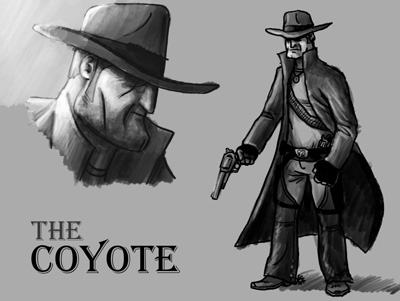
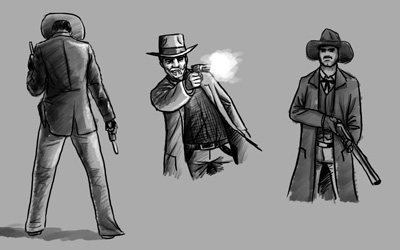
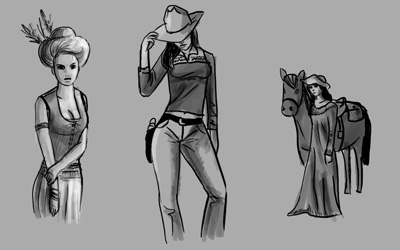
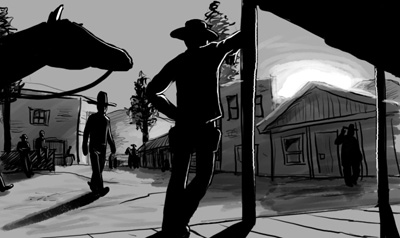
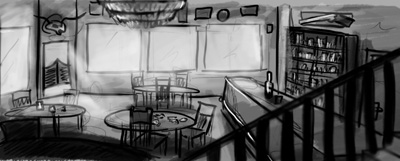
    This is some concept art for a game concept I came up with last semester.

  • What there is up

    I started the Game Design and Development course at the HKU college a few weeks ago. Frankly I can’t think of anything I’d like to be involved in more, and it’s been a blast so far. We’ve got a great group of creative minds and we get to think, talk, learn and play games all day. We get classes on all of that, and there’s a special room on ‘our’ floor with a couple of big sofas, some HDtv’s and a bunch of consoles to play games on. It doesn’t really feel like school at all!

    On Monday morning, we get lessons in seperating design and content, as you would with HTML and CSS, so we’re building a website this term; Tuesday’s is Project day, where we get together and storm some brains abut what interactive application we’ll be building; Wednesday we do some Research and afterwards a bit of Pixel Art; Thursday’s we get to sleep late and come in for some Coding and Art Class; and Friday we tackle Interaction Theory, which basically means doing fun experiments and looking at optical illusions and crazy designs with a man who looks strikingly much like a character I designed. Inbetween we run around town sometimes, and ofcourse play games, and that’s basically it!

    I’ll post some pictures soon.